
Books: When deviating from reporting, author interviews were a great escape
Authors toil in obscurity. It's important to hear their voice on the book's release.

My day job for years was straight news reporting on the Great Lakes, water issues writ large, environmental justice and more. Somewhere along the path I convinced an editor to let me focus on interviews. People like Michigan governors, EPA execs and environmental attorneys.
But a most welcome subset was book authors, and they’ve recently been top of mind as I interviewed two in the last month. Both were pegged to the release of new books. The Great Lakes region’s Dave Dempsey and Europe’s Giulio Booccaletti.
A third interview with a prominent Canadian author is on the horizon.
I’ve known all three over the years so there’s a familiarity, what to expect and they don’t disappoint. Stylistically, Dempsey is a sparse writer. He elaborates and takes a deep dive when necessary, but leans toward being concise in a way that you understand the message conveyed.
Boccaletti, a scientist, is a deep explainer of the details and that can be a challenge. But details are there for a reason. They support complex premises or historical events and once I got into a groove with his style, I found it rewarding.
The Canadian author will fall somewhere in the middle. Above all, she will be candid, then an explainer and she will bring enthusiasm and an occasional hard edge to the work.
I’m pleased to feature them in this space.
The recent interviews prompted me to look back at the 20 or so author interviews I’ve done including a couple of filmmakers.
Disclosure: My wife has written three books, two of them award-winning. So I’ve been on the inside of what it takes to go from an idea to a published work. It’s a daunting task that plays out over time but is ultimately rewarding. Thus, my affinity for authors.
A short list
Here, a short list in addition to Dempsey and Boccaletti of authors out of the 20 interviewed and a comment or two - something that struck me about them or the work.
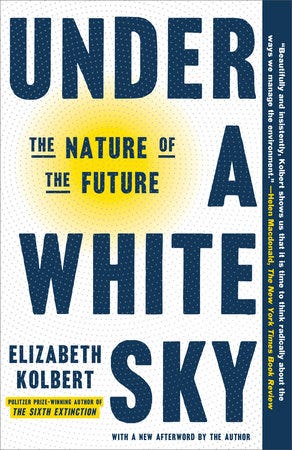
Elizabeth Kolbert
On a chill, rainy day in 2022 I was scheduled to interview Elizabeth Kolbert. She was on the campus of Northwestern University in Evanston speaking on her book, Under a White Sky: The Nature of the Future. Kolbert was more than a little late and walked into the hotel lobby sans umbrella soaking wet. I wasn’t sure what to expect. She seemed hurried and I feared a less than rewarding interview.
What she delivered was spot on, unhurried responses to my questions. They were well considered, concise and she pushed back when appropriate as I would expect from a Pulitzer Prize winning author. Interview complete and Kolbert said, do you have what you need? I did and after parting pleasantries, off she went to her next event. What a pro.
The interview is here. https://www.greatlakesnow.org/2022/10/19/great-lakes-chicago-river-asian-carp-elizabeth-kolbert/
Jane Elder
Jane Elder had a long and successful environmental advocacy career by the time I first encountered her. It was at a meeting of advocates with the head of the USEPA’s Great Lakes office in Chicago. The meeting, from memory, seemed perfunctory until Elder pointed out deficiencies in the agency’s Great Lakes work. I took note.
Fast-forward to her sort of end of career book, Wilderness, Water and Rust: A Journey Toward Great Lakes Resilience. I interviewed Elder in 2024 on its release for a couple of reasons. She combined her professional environmental work with her personal life experiences because they are intertwined. And she had the audacity to include Rust, in the title. As in the Rust Belt, a term eschewed in the Great Lakes region but commonly referenced elsewhere.
The interview is here.
Sally Cole-Misch
In 2020 my Great Lakes Now editor asked me to take a look at Sally Cole-Misch’s book, The Best Part of Us, as an author interview candidate. It was a novel about a generational conflict between owners of a vacation home in Canada and the local Ojibwe chief who claimed the land. The backdrop was the Lake Huron area.
I was reluctant because I rarely read fiction, but I took a look and said yes. What I discovered was an engaging work by Cole-Misch as she put a spotlight on our often overlooked but undeniable connection with nature. While raising questions about who, if anyone can really own land. Spoiler, we’re still grappling with the question, she said.
I remain wary of fiction but am grateful to have read The Best Part of Us.
Interview here
https://www.greatlakesnow.org/2020/09/04/great-lakes-author-conflict-culture-novel/
Flawed process
Lists like this are inherently flawed as they are not all-inclusive. Following, authors interviewed and not mentioned above but who are no less worthy of a mention.
Jerry Dennis for The Living Great Lakes, the book that drew national attention to the lakes. Peter Annin for Great Lakes Water Wars chronicling diversion threats of water to arid areas, and Erica Gies for her expansive and “quietly radical” Water Always Wins.
And two Filmmakers. Detroit’s dream hampton for Freshwater on water, life and justice. And Boston’s Mary Mazzio for Bad River, on the Line 5 oil pipeline in Wisconsin.
My thanks to the authors for the time and courtesy extended.
~ gw
Note: dream hampton does not capitalize her name.
Photo: Penguin Random House
Gary, as always interesting and enlightening.