
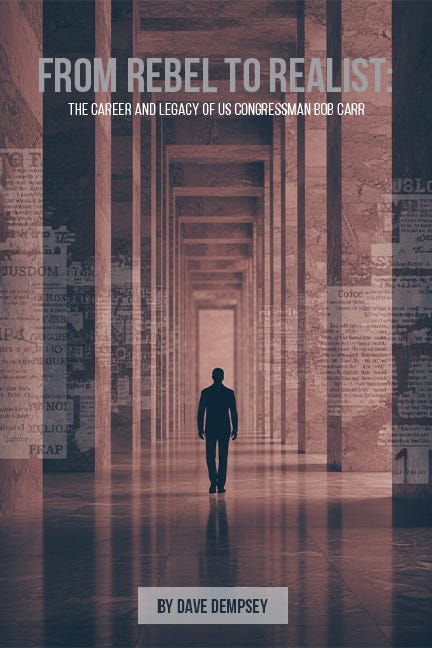
Author interview: Dave Dempsey's latest, From Rebel to Realist, chronicles a Congressman's "roller coaster" career
The late Bob Carr was not your average Washington bound politician. He was on a mission to upset the status quo. Success and an education in D.C. politics followed.

Michigan’s Dave Dempsey has worn a lot of hats over a long career. Among them are policy adviser, author and environmental advocate. You can now add historian to the mix.
Dempsey’s new book, From Rebel to Realist, examines the career and life of Rep. Bob Carr, a Democrat who was first elected to Congress in the Nixon Watergate era. Carr, 31, sensed it was time for change, nothing short of a disruption of the staid ways of the U.S. House and he was going to be a change agent.
With the rigor of a historian. Dempsey documents how Carr and incoming colleagues challenged the order of the House and its iconic leaders. And they were successful, to a point. But over time, things changed and Carr had to adapt.
I asked Dempsey to explain and he agreed to an interview.
He talked about his reasoning for the book, the inner workings of Congress, the barriers Carr faced in trying to reform it and the consequences for being a young rebel who bucked the system and its leaders. He included his take on how Carr would view the current dysfunctional Congress that defers to the executive branch abdicating its role in the check and balance system
Bob Carr died in 2024 at 81.
The interview was conducted via email and was edited for length and clarity.
Gary Wilson: We should start by disclosing that you served two years on Rep. Bob Carr’s staff, 1980-1982. So you have not only an insider’s perspective but also the advantage of distance, as he left Congress in 1995. What prompted you to chronicle his life and career now?
Dave Dempsey: Two things. He passed away in the summer of 2024, and his family asked me to go through his papers, including personal journals that his daughter shared with me. I found a story about Congress that I think has relevance today. Also, it was time for me to wrestle with what his life and career meant. The subject has been on my mind for years.
GW: In the introduction you wrote that your research led you to write about the “roller coaster trajectory” of Carr’s political career. Plus it provided a view of where Congress and the country “traveled from the early 1970’s to the mid 1990’s.” Can you elaborate on both?
DD: Bob had two Congressional careers. In the first, he served three terms and shook things up in the U.S. House. Then he suffered a shocking defeat that caused him to rethink his approach. Two years later he won re-election and was an almost completely changed officeholder. He focused on bringing home federal dollars to the district and to Michigan, and was darned good at it. And then his career ended in a crushing defeat in the 1994 U.S. Senate race. Some people said that it was because he was a chameleon.
It happens that the 20-year span in which Congress was his professional home was the end, at least for decades, of Democratic dominance of the U.S. House. Why did that happen? Changes in the populace for sure, but also the unintended consequences of the House reforms that Bob and other rebels of the class of ’74 pushed through.
GW: The “chameleon” charge sounds harsh. Was that a fair assessment or election campaign rhetoric?
DD: It’s too harsh. The word implies a constant flip-flop to stay in office. Carr may have drifted to the right during his final terms in Congress, but the bigger change was that he chose to focus on what I’d call ‘good’ pork barrel funding rather than larger issues.
GW: You took readers deep into how Congress functions. Often derisively referred to as how the sausage - the legislation - is made. Why was that important in order to understand Bob Carr the legislator?
DD: You can’t understand life in Congress without having a sense of that. And Congress was his world.
Besides, I think every citizen should know as much about how a law is made as he or she knows about how a professional basketball player makes a perfect pass. (cont.)
GW: Do a search for the most prominent Michigan members of the U.S. House from 1970-2000 and Carr’s name appears along with stalwarts like John Conyers and John Dingell - Democrats and William Broomfield, a Republican. How did he stack up against those peers?
DD: Good question. Let’s focus on John Dingell and Bob. Carr displeased Dingell in his first Congressional stint, taking positions in areas of Dingell’s expertise (the auto industry especially) without consulting him much. In his second stint, he worked closely with Dingell. He recognized the importance of working with the dean of the house.
Bob did a lot of interesting things in Congress, but there’s only one John Dingell.
GW: If Carr could see the current state of Congress, which is deeply divided, marginally functional and subservient to the president, how would he react?
DD: I don’t have to guess. He lived long enough to see the mess in which Washington now exists. He hoped to live long enough to see Trump defeated in 2024 (but died in August). He saw Trump as an existential threat to our government and society.
But –and this is important – he was not terribly dismayed by Congressional gridlock. At least in his later years, he concluded that the Constitution was written as much to prevent bad ideas from becoming law as it was to facilitate good ideas to become law.
GW: As I read about Carr’s “rebel” phase early in his first term, Democratic Rep. Alexandria Ocasio-Cortez from New York came to mind. Or for Republicans the Tea Party representatives who challenged President Obama on spending. Similarities?
DD: Great similarities. Bob was part of the Class of ’74, when dozens of young Democratic freshmen were swept into office as voters reacted to Watergate. He took it as a mandate to change the way Congress functioned. He was very public about the ethical breaches and arrogance he saw in the Capitol. In that regard – and charisma – he reminds me of Ocasio-Cortez. It’ll be interesting to see whether she mellows or moderates to get things done and/or to get re-elected.
But that kind of candor also cost him. When he dared blast the Democratic speaker of the house, Carl Albert, it generated a backlash against him that he said took years to overcome.
GW: Are there any Bob Carr type politicians emerging in Michigan? Perhaps Democratic Sen. Elissa Slotkin? Others?
DD: I don’t see any. Slotkin is an effective Senator but I don’t think you’d ever see her outspokenly attacking her own party’s Congressional leadership. If there aren’t any Bob Carr type politicians emerging in Michigan, it’s partially because we’re not electing 31-year-olds like Carr was in 1974. We’re electing and re-electing octogenarians. They tend not to be firebrands.
GW: What do you hope readers will take away from Rebel to Realist?
DD: On one level, an understanding of how a person and public figure operated in the Congressional environment during a remarkable period in our history. On another level, trying to understand the balance between principle and pragmatism. As we age many of us come to see that life is not all black and white. But how far do you go in altering your positions without losing touch with your principles?
GW: In his comments on From Rebel to Realist, Michigan U.S. Sen. Gary Peters said Carr “brought people together to find the middle ground necessary for lasting progress.” Is that even possible in today’s toxic political environment?
DD: It’s a long shot. Polls show that a large number of conservatives view liberals not just as people with a point of view different from their own but as the enemy, and vice versa. It’s hard to find middle ground with an enemy.
Actually, Peters has come as close as anybody, working out a few constructive bipartisan deals, such as a Great Lakes Coast Guard program to examine the impacts of oil spills in freshwater environments and help develop effective responses.
~ gw
Book cover art: Eugenia Collazo
From Rebel to Realist is available on Amazon.
https://www.amazon.com/-/es/Dave-Dempsey-ebook/dp/B0GSKZYXRL
More here on Dave Dempsey’s books.
Gary - Interesting. I guess I never really knew about Bob Carr, I probably wasn't following things that closely at the time. From one perspective Carr was no different than most in Congress today, in that keeping one's job in Congress is the highest priority. While everyone wants to keep their job, a little less of that would be helpful. The book seems worthwhile just for the perspective on life in Congress.
Informative interview. I read it and then saw that Don Riegle had died. Hadn't heard of him in years and didn't know he was still alive. Of course, he (unlike) Carr managed to get into the Senate after a few years in the House.