
Author Interview: Canada's Maude Barlow
In "Earth for Sale," Barlow "exposes the danger" in privatizing natural resources. "When will we say enough?"

Recently in this space commenting on author writing styles, I said you can count on Maude Barlow to bring candor, enthusiasm and an occasional hard edge to her writing.
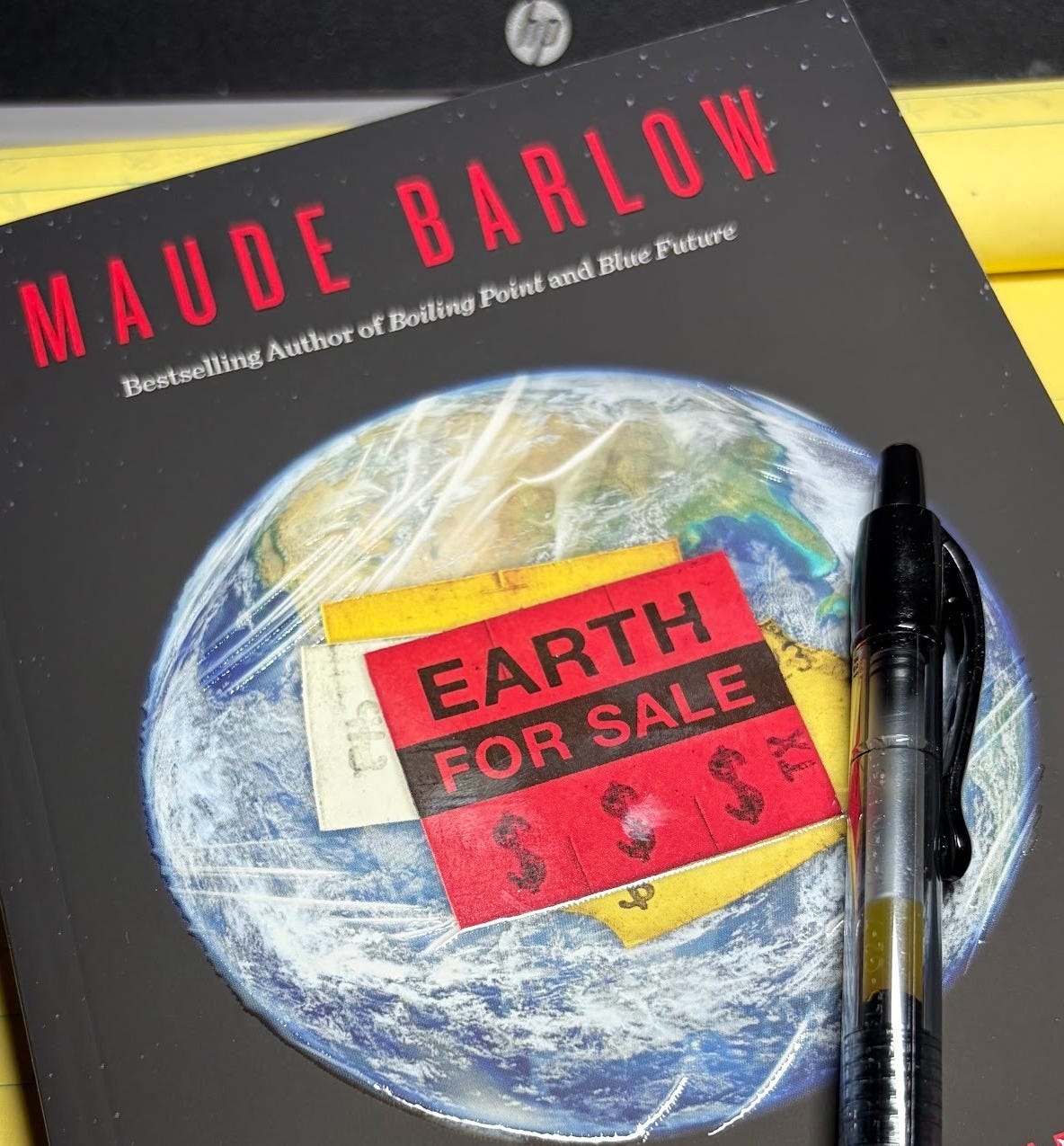
Barlow remains true to form in her new release, Earth for Sale: The Fight to Stop the Last Plunder of the Planet. (ECW Press)
In a concise 186 pages Barlow “exposes the danger” of governments giving responsibility for climate action to “powerful private interests,” the same entities that have brought the planet to the brink, she wrote.
Barlow has a long career as an international environmental and social justice advocate, and is best known for her work advising the United Nations on the human right to water.
Her previous works on water include Boiling Point and Whose Water Is It, Anyway?
I recently interviewed Barlow pegged to Earth for Sale’s release where she addressed questions on privatization and financialization of Earth’s resources. She explained the concepts of water offsets, water pollution trading and ocean grabbing. And Barlow made the case for continuing the fight against bottled water in spite of regulatory inertia and consumer demand.
The interview was conducted via email and edited for length and clarity.
Gary Wilson: Earth for Sale’s premise is that most of us on the planet “agree on the need for climate action, yet we are often divided on how to stop the destruction of the natural world.” Your concern is that governments are abdicating their responsibility in favor of corporate interests. Can you elaborate?
Maude Barlow: Governments are either saying that the climate and biodiversity crises are not real (the Trump administration) or that they don’t have the funds to clean up the damage that’s been done. So they are openly contracting out their responsibility to care for their forests, wetlands, waterways and wildlife to the private market hoping to attract large pools of private funds to invest in nature.
The problem of course, is that private investors will need to turn a profit from these investments and they are now making money cleaning up the very mess their corporate sponsors made in the first place.
Financialization
GW: Historically when we talk about climate and responsibility for the dire straits we’re in, our knee jerk reaction has been to blame fossil fuel companies, big oil. Now, you throw global equity funds, asset managers and private water utilities into the mix with a combined total of 45 references to privatization and financialization. Most will understand privatizing. But financialization warrants an explanation.
MB: This is crucial to the story. The same corporations and industries that brought us to the ecological brink are now - with the support of governments, the UN and the World Bank - taking over the climate and biodiversity file. Their answer to the crises: bring nature into the market, put a price on it and let the market - not governments - decide its fate.
The financialization of nature is the process of converting nature, ecosystems and the so-called “services” they provide, into tradable financial assets that then compete on the open market. Instead of government regulation, nature is now “protected” by its ability to make a profit. The way it works is that a company or industrial operation can continue to pollute as long as it promises to “offset” its damage elsewhere. Because there is so much money to be made from plundering nature, the big equity funds and asset managers have become deeply involved, claiming to support “sustainable” investments, when in fact, the system is allowing more and more exploitation of resources.
The financialization of nature is like giving the fox responsibility for the hen house. Are we better off with nature being “protected” by private capital? Our waterways are more polluted than ever, our forests and wetlands are being decimated and our air more fouled and dangerous. We desperately need governments to rein in the power of big corporations and billionaires and protect the living world upon which we all depend to survive.
GW: The water chapter is titled, The Fight for Blue Gold. Blue Gold as a metaphor for fresh water. In it you reference diverted water, dammed rivers and “greedily pumped groundwater” among the major concerns. These are legacy issues that didn’t just recently emerge. Why haven’t we addressed them? It’s not like the U.S. and Canada lack expertise and resources.
MB: Of course it comes down to political will. Our two countries have found this will in the past with the creation of the International Joint Commission and several key agreements such as the Great Lakes Water Quality Agreement. At various times, the Canadian government has pulled back funds for Great Lakes protection and at other times, the US has done the same. But the spirit of cooperation is still incredibly strong.
However in this time of deregulation, we are exposing the Great Lakes to new threats such as the hundreds of AI data centres either existing or planned in the Basin as well as the search for new fracking sites. The St. Lawrence River is in serious danger with habitat degradation, warming and over-extraction of its groundwater. And of course, in both our countries, the search for critical minerals and new energy sources endangers water that is no longer protected by federal law.
Bottled Water
GW: In my 20 years of reporting, bottled water has been a poster child for corporate taking of a natural resource. Activists in Michigan had early success in limiting Nestle’s water withdrawals but over time, Nestle and its successors prevailed as determined by the state of Michigan’s rulings. Big box stores have entire aisles devoted to bottled water because there is public demand for it. Isn’t the bottled water issue settled?
MB: We must not give up the fight against bottled water! We have the right to safe and clean, public water in our communities, and to have to rely on plastic to bring us water should not be accepted as normal. The world is drowning in plastics and yet the bottled water industry is set to explode with predicted sales to reach US$600 billion in five years. People and communities are subsidizing the huge profits these companies make for bottling their water, so of course, why would they want to encourage legislation that would stop water pollution?
GW: In Earth for Sale, you use terminology in the water chapter that some may not be familiar with - water offsets, water pollution trading and ocean grabbing. At a high level, will you provide a brief explanation of each and why you’re concerned about them?
MB: Water offsets act the same as carbon and biodiversity offsets. Carbon offsets give a polluting company a tradable credit for every metric ton of greenhouse gas they claim to have prevented elsewhere, such as by planting trees. Biodiversity offsets place a value on an animal, plant or habitat that allows a company to continue to harm an ecosystem as long as it “offsets” its damage by, say, recycling plastic in a poor community of the global South.
Water offsets allow a corporation to continue to pollute or over-extract water and get a tradable credit for, say, digging boreholes in Africa, or investing in “green” energy such as lithium production (which destroys local water). Poor countries in need of funds openly tout “cheap water” as an incentive to invest in their monoculture tree plantations or mass alfalfa export operations. Bottled water companies can claim to reach their “water neutrality goals” by buying from companies that own the land and water, who, in turn, make money selling credits to those bottled water companies.
Water Pollution trading, another form of water markets, is also called “water quality trading” or “water nutrient trading” by proponents. Water pollution trading is a market-based approach to protecting lakes and rivers overloaded with industrial, human and animal waste. It allows a polluter to maintain pollution levels that are higher than allowed by local regulations, by selling credits to another source. That source, in turn, uses the credits to reach its own regulatory compliance. Many of the projects centre on lakes that are contaminated with eutrophication, nutrient overload that depletes oxygen in the water.
One of the world’s largest and oldest projects is in the Chesapeake Bay. Claiming to help offset the ecological damage to the bay, the EPA supports this “market-based approach,” explaining, “Trading can allow one source to meet its regulatory obligations by using pollutant reductions created by another source with lower pollution controls.” Food & Water Watch reports that pollution trading has allowed giant factory farms to continue to dump huge amounts of nitrogen and phosphorus into the waters of the bay.
Ocean grabbing is one of the newest forms of nature grabbing in the planet’s oceans. Blue carbon refers to the carbon sequestered in coastal ecosystems, mangroves, seagrasses and salt marshes. To make a profit from this sequestered carbon, blue bonds have been created to provide a new opportunity to generate credits for companies wanting to offset their own negative carbon or biodiversity footprint. There is big money to be made from “protecting” these coastal ecosystems, including aquaculture, ecotourism and the search for rare earth minerals on the seabed. Already in the name of the blue economy, small-scale fisher peoples are being displaced for commercial operations.
Adam Smith redux
GW: You close the Blue Gold water chapter citing 18th century economist and philosopher Adam Smith, author of The Wealth of Nations. Paraphrasing, Smith warned against privatization of what is produced naturally. Will you explain the relevance of Smith’s words all these centuries later and why you cite him?
MB: Smith was saying that those who did not do the work, get to reap the reward. We live in a world where, soon, a cohort of trillionaires will walk among us. They live above any law anywhere and are reaping huge fortunes from polluted water, dying species and out-of-control wildfires. When will we say, enough?
GW: Here’s the, it’s the economy, stupid, question. In recent years increasingly I’ve seen references to environmental protection linked to economic growth as if they go hand in hand. For example, Trump USEPA administrator Lee Zeldin talks about meeting the agency’s mission while “energizing the greatness of the American economy.”
Similarly in Michigan, the head of the state’s environmental agency under a progressive governor, Gretchen Whitmer, said when appointed - “We have a tremendous opportunity to seize the moment and take action to grow Michigan’s economy, protect our land, air, and water — today and into the future…” Isn’t there an inherent conflict of interest? Won’t the economy always win?
MB: Yes, there is an inherent conflict when the economy is favoured over the environment. We can actually have both a healthy environment and economy but not if we continue to cut government protections for our natural resources and hand the responsibility for the environment to the very people who are destroying it.
There is no life worth living on a dying planet and we must wake up to this soon. The AI boom is a perfect example of the economy (for the rich) taking clear precedence over the environment. The water destruction alone will take a long long time to heal and meanwhile, local farms and economies are being devastated.
And, as the climate crisis hits in the form of floods, hurricanes and fires, who will insure our homes and businesses? Taking care of the environment is job number one for a healthy economy.
GW: For a family in Ottawa or Detroit that doesn’t know or care where its water comes from - as long as it’s abundant, affordable and clean. What would you want them to take away from Earth for Sale?
MB: The planet is running out of clean accessible water. The UN reports that demand is already exceeding supply and that it is getting exponentially worse. We can all wait until it hits us or we can take proactive measures to protect water and the human right to water everywhere. We can start that process by saying no to the corporate capture of nature and water.
GW: Final thoughts for the residents of the eight Great Lakes states and two Canadian provinces?
MB: We have created something special here - a family of two nations, two provinces and eight states - who care for these precious lakes and one another. May this be a blueprint moving forward in the spirit of cooperation and respect. In spite of my concerns about the world, I have great hope and want to pass it on to the younger generation.
~ gw
n.b. The Maude Barlow interview is the last of the author interview series, Previously featured were Dave Dempsey and Guilio Boccaletti. Thanks to the authors for contributing.